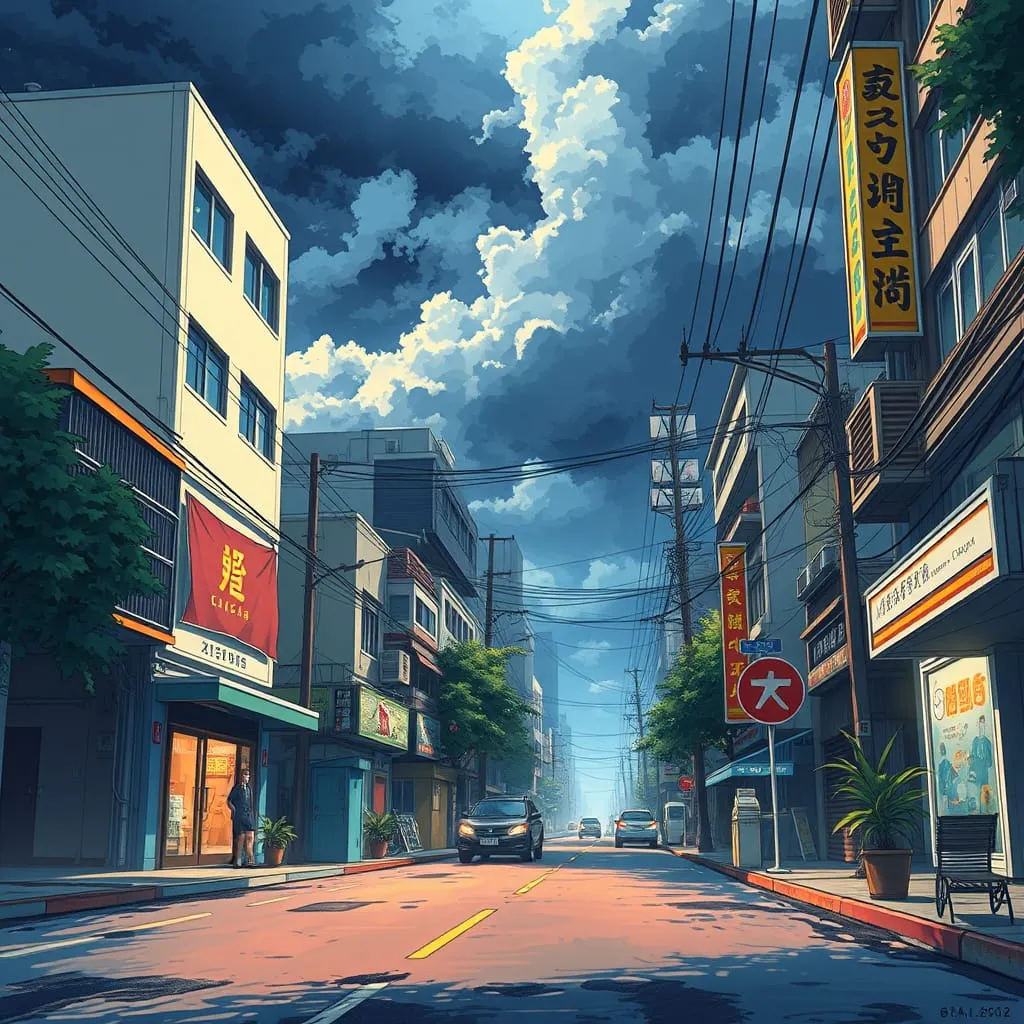
The air hung thick with humidity as the brewing of a storm could be felt in the air, cicadas weaving their final symphony through the gauze of heat that wrapped the city like a shroud. Satoshi and Kenji traced the long path home from cram school—not from necessity, but because Kenji had insisted the dappled shade beneath the park's ancient trees might clear the fog from his mind before he faced another evening of his mom’s weaponized silence.
They threaded through a narrow alley that carved its way past a weathered Shinto shrine, its vermillion torii gate standing defiant despite the rust that bloomed across its surface like autumn leaves. The air carried the weight of centuries—stone worn smooth by prayer, the ghost of saké offerings sweet and fading beneath the sharp scent of sun-baked asphalt.
Satoshi's gaze lingered on the small shrine as they passed, drawn by something he couldn't quite name. The modest altar was barely visible through the shadows, but he could make out the offerings left by faithful visitors—small bowls of rice, paper charms fluttering from ropes, coins scattered on weathered wood.
"Hey, check this out," Kenji said, pulling out a paper with enthusiasm. "My cousin in Osaka sent me this application for some international program. He said that since I’m starting my last year of highschool, I should start looking at things like this"
He thrust the paper toward Satoshi, displaying a colorful application. "International Studies and Experience Design. They want you to spend every semester in a different country, studying how everything connects across cultures and disciplines."
Satoshi glanced at the paper, noting the unconventional questions. Very Kenji. "Sounds like they want professional procrastinators."
"Exactly!" Kenji's grin was infectious. "But here's what got me—they're asking 'What's more valuable: becoming an expert in one field, or developing fluency across many?' Like, who even says that? Everyone else wants you to pick a lane and stay in it forever."
"And you'd pick fluency across many," Satoshi said, though something in his friend's excitement made him acutely aware of his own lack of direction.
"Because why would I want to spend my whole life talking to the same five people about the same narrow thing?" Kenji's enthusiasm was bright, uncomplicated. "There's this whole world of connections nobody sees—how people build cities around sacred spaces, how design solutions ripple across continents. Everything's connected if you look at it right."
"Sounds expensive," Satoshi offered weakly.
Kenji paused, something sharper entering his voice. "That's what you're focusing on? The cost? I'm trying to share something I actually care about here."
"Sorry. It sounds perfect for you."
"Perfect for me." Kenji repeated the words like practicing the sound of a discordant note. "Right. Because I'm the scattered one who can't focus, and you're the serious one who thinks about practical things." He studied his friend's face.
The words hit harder than Satoshi expected. "I'm sorry. You're right—it does sound incredible. Imagine studying how people build meaning in different places, how the same human impulses show up everywhere."
His gaze drifted back to the shrine they'd passed, deciding to let it go. "That shrine back there—someone's been leaving rice there for decades, probably. One bowl of rice, but it's actually this whole web of meaning and relationship and hope."
"What about you though?" Kenji asked, and now his voice carried a different kind of intensity. "You still haven't picked a major. Or a school. Or like, a general direction. And I know you could do anything—top scores in every subject, that weird photographic memory thing you pretend you don't have. So why are you so paralyzed by choice? And don't give me another non-answer."
The directness of it made Satoshi want to retreat into his usual deflections. But something in his friend's expression stopped him. Kenji was offering him something rare: the opportunity to be real.
"It's not that I have too many choices," Satoshi said slowly. "It's that I feel like... like I don't actually get to choose. Sometimes it feels like your life gets decided for you. Like there's only one path that makes sense, even if it's not the one you would have picked."
"Is this about your parents? The pressure to—"
"No. Not my parents." Satoshi looked away. "Just... circumstances. Things you can't control that end up controlling you."
"That's pretty cryptic, even for you." Kenji's voice softened. "But maybe that's the point, you know? Maybe the most important changes happen when nobody's watching. What would your perfect life look like, though? What do you want to do?"
The question stopped Satoshi's thoughts completely. His perfect life would be one where he could use his abilities openly, where he could save everyone who needed saving without hiding behind the mask of ordinary humanity. Where his heroism wasn't measured in anonymous interventions and invisible miracles.
But that life was impossible. The world wasn't ready for what he was.
"I don't know," he said, and the honesty of it surprised him. "I honestly don't know."
"Do you think you’re cousin knows?" Kenji's smile was easy, uncomplicated by the weight of cosmic responsibility. "He seems like the type who is satisfied with his answer."
"Perhaps," Satoshi nodded, but his response felt automatic, distant.
Kenji studied him for a moment. "You know, for someone who just shared something real with me, you're already retreating again."
"I'm not retreating."
"You are. You get this look—like you're watching our conversation from somewhere else instead of actually having it." Kenji's tone was gentle but pointed. "I'm right here, you know. You don't have to perform being my friend."
They resumed walking, and Satoshi tried to imagine what it would feel like to live with Kenji's kind of uncertainty—the exciting kind, full of possibility rather than paralysis. To see scattered interests as strengths rather than weaknesses. The gentle rebuke in those last words wasn't lost on Satoshi. Kenji was giving him another chance to be present, to be real in their friendship instead of just going through the motions.
Satoshi was about to respond, perhaps with some degree of truth, when his attention fractured and reformed. He felt a familiar whisper of structural weakness, a whining note in the symphony of forces that held the world together. Not catastrophic. A gutter bolt singing its last song of resistance. A balcony tile loosened by thermal expansion and time.
And below, moving through the space where gravity would soon claim its due: a child.
The feeling dissolved and his body responded before his mind could catalog the ethics of intervention, fingers shifting behind his back in a gesture that looked like nothing more than adjusting his bag strap. The forces that governed falling objects bent around his will—pressure redistributed, trajectory adjusted, momentum redirected with the precision of a surgeon's blade.
The tile separated from its moorings in perfect silence. The child below continued her innocent exploration of the world, unaware that death had passed within centimeters of her skull. The ceramic fragment settled into a garden hedge with the softness of a whispered secret, crushing flowering branches instead of fragile bone.
No sound. No alarm. No disturbance in the peaceful rhythm of the afternoon.
Only the mother.
She turned as if pulled by invisible strings, her gaze finding the crushed foliage, the gap where the tile had been. Understanding flooded her features—not the mechanics of what had happened, but the terrible mathematics of what hadn't. Her daughter, safe and oblivious. The hedge, bearing the impact meant for something infinitely more precious.
She gathered her child against her chest, tears transforming her face into something luminous and raw. Her lips moved in the ancient language of gratitude, words that had been spoken in ten thousand moments of unexpected mercy:
"Arigatou... kami-sama... thank you... thank you..."
Each word fell like a pearl on the thread of absolute belief, strung together by the certainty that someone else—something else—had heard her unspoken prayer and found it worthy of an answer.
"—so anyway, what do you think?" Kenji's voice continued its meandering journey through application logistics, but Satoshi had become a statue, his breath caught in the space between recognition and revelation. He stared—not at the hedge, not at the shrine, not at the child—but at the mother. At the words spilling from her lips like offerings, each one carved from the bedrock of faith that the universe had tilted in her favor.
It had. He had been the one to reach across the impossible distance between intention and reality, to move the world by fractions of millimeters that contained the difference between tragedy and Tuesday afternoon.
The weight of that realization settled into his bones like lead. Without his intervention, the child would be dead. Not injured—dead. A small skull crushed beneath ceramic and concrete, a life extinguished in the space between one breath and the next. The mother would be screaming. Blood would be spreading across the pavement. Emergency sirens would be wailing through the afternoon air.
And then, like a door opening onto an infinite corridor of horror, came the next thought, a thought he had tried to shove down so many times before: How many times was this exact scenario playing out across the world right now? How many children were walking beneath loose tiles, corroded balconies, weakened infrastructure in cities from Tokyo to São Paulo to Lagos? How many prayers were being whispered by mothers who would never receive the miraculous intervention that had just saved this one child?
Hundreds. Thousands. Every single day, gravity claimed its due while he sat in student council meetings and pretended his biggest concern was festival planning. While he slept, while he ate lunch, while he worried about homework—somewhere, a tile was falling toward someone who had no invisible guardian to redirect its path.
The scope of it threatened to crush him. All the tragedies he could prevent if only he were there, if only he knew, if only he didn't have to hide what he was. All the mothers who would bow to empty shrines tonight, their prayers unanswered because the only person who could have helped them was half a world away, living a careful life of deliberate smallness.
"Hey, Satoshi, are you okay?" Kenji's voice, truly concerned, cut through the crystalline moment, dragging Satoshi back to the ordinary world of friendship and footsteps and the weight of pretending to be merely human.
"Yeah. Just..." The lie felt familiar and painful, a joint that ached whenever it rained. "Thinking about what you said."
"Right." Kenji's voice carried the particular concern of someone who had learned to read the silence between words but the same edge of someone who had been refused entry too many times.
He continued onward, while heat bloomed beneath his ribs—not anger, never anger, but something sharper and more complex. A recognition that cut both ways: the terrible beauty of being exactly what someone needed and the hollow ache of being invisible in your own act of grace.
The mother was still holding her child, still whispering her thanks to gods who had done nothing—literally nothing—while the person who had actually reached across physical laws to save her daughter stood three meters away, unknown and unacknowledged. The kami in that weathered shrine had never moved so much as a dust mote to help anyone. They were stone and wood and human belief, powerless as the paper charms that fluttered in the breeze.
But he—flesh and blood and impossible ability—had bent reality itself around this woman's unspoken prayer. He had been the divine intervention she would spend the rest of her life thanking gods for. The real miracle worker, dismissed as a schoolboy while ancient myths received the credit for his labor.
"Want to grab ramen?" Kenji asked as they turned the final corner toward home, apparently sensing his friend's need for something normal and immediate. "All this talk about the future is making me hungry for something that requires zero life planning."
“No…no…I have to get home…” He said, looking at the sky. “I’m sorry Kenji”
Kenji shrugged. “Oh that’s fine” He said, accepting that his friend, in whatever state he was in, he was in no mood to talk. “Be safe out there”
Satoshi nodded, and then turned away his eyes grimacing as he made his way quickly down the street while the wind picked up and small droplets began trickling across the street.
The only thing Satoshi could think of as he picked up the pace, the relentless arithmetic. One saved. Hundreds not saved. The pressure differential building in his chest like a storm system approaching critical mass.
The rain had intensified by the time Satoshi reached his apartment building, the wind beginning to gust in a way that made the streetlights sway. The cicadas had gone completely silent now. Even Maru, who usually prowled the lobby in the evenings, was nowhere to be seen—probably hiding under the stairs, some animal instinct recognizing systems under stress.
He pushed through the lobby doors, shaking water from his jacket, and immediately the television's murmur cut through the white noise of rain:
"...tropical system showing rapid intensification over the Bay of Bengal..."
His body stopped moving before his mind registered the command. The key to his mailbox hung forgotten in his hand.
"...coastal Myanmar should prepare for severe weather conditions... meteorologists express concern about the unprecedented rate of intensification..."
The screen showed satellite imagery—a swirling mass of clouds that looked deceptively organized, almost beautiful in its terrible symmetry. But it wasn't the visible he was responding to. It was the humming sensation, the same one he'd felt from that loosening bolt, amplified a thousandfold. A system under stress. Pressure differentials building beyond what forecasters understood, beyond what their models could predict. The eye wall tightening toward something catastrophic.
His momentum field expanded involuntarily, searching, reaching—but all it found was the solidity of concrete and steel around him, the ordinary structural integrity of a building designed to withstand Tokyo's earthquakes. Nothing he could affect from here. The storm was thousands of kilometers away, a system too vast to touch from this distance.
"...landfall expected within eighteen hours... residents in low-lying coastal areas urged to evacuate immediately..."
Eighteen hours. His mind began calculating automatically: distance, speed, what he could do if he left now. He could reach the coast before landfall. He could—what? Redirect wind patterns? Disrupt the pressure systems? He'd never attempted anything on that scale, never tested the upper limits of his abilities because testing them meant revealing them.
But this was different. This wasn't about testing limits. This was about hundreds of thousands of people living in homes that would dissolve like paper under what was coming. Villages built at sea level. Fishing communities with nowhere to evacuate to. He'd seen the documentaries, knew the geography—the Irrawaddy Delta, densely populated, completely exposed.
He turned toward the door looking out at the street again. He could do this. He could leave now, be there before dawn, before the worst of it hit. No one would see him in the chaos of the storm. He could work under cover of wind and rain and—
"Satoshi-kun!"
The warm voice cut through his spiraling thoughts. Mrs. Ishikawa emerged from the elevator, arms full of grocery bags, her round face lit with genuine pleasure at seeing him. "Perfect timing! Could you help an old woman with these?"
He stood frozen, caught between the television's murmur of approaching catastrophe and the immediate, human warmth of his neighbor's smile. His hand was still on the door handle. Myanmar was eighteen hours away. Mrs. Ishikawa was right here, three meters away, struggling with bags that were cutting into her palms.
"Satoshi-kun?" Mrs. Ishikawa's expression shifted toward concern. "Are you alright? You look pale."
"I..." The words stuck in his throat. Through the lobby windows, he could see rain falling in sheets, the storm overhead intensifying. Not as severe as Myanmar, not yet, but the same principle—systems building toward crisis while ordinary people went about their evening routines, trusting that someone, somewhere, was watching out for them.
Someone like him.
Except he was standing in a lobby, doing nothing.
"I'm fine, Ishikawa-san." He forced his hand to turn towards her, forced his feet to move toward her, forced himself to take the heavier bags. "Let me help you with those."
"You're such a good boy. Always so helpful." Her smile was uncomplicated, unburdened by the knowledge that 'helpful' meant carrying groceries while thousands of kilometers away a hurricane bore down on people who had no invisible guardian to redirect its path. "I was just making too much sukiyaki again—my eyes are bigger than my stomach these days. Would you like to come up for dinner?"
Behind them, the television droned on: "...residents urged to evacuate low-lying areas... international aid organizations pre-positioning supplies..."
Here was an escape. Here was permission to be finite, to accept the boundaries of ordinary human kindness. Mrs. Ishikawa wasn't asking him to save Myanmar. She was asking him to share a meal. Simple. Manageable. Human-scaled.
"That's very generous of you," Satoshi heard himself say. "I wouldn't want to impose—"
"Nonsense! A growing boy needs proper food." She pressed the elevator button with her elbow, and the doors opened like a mouth, ready to swallow him into warmth and normalcy and the comfortable lie that his only responsibility was to be a polite neighbor. "Besides, I've been meaning to ask how your mother is doing. I haven't seen her at the building meetings lately."
Satoshi's mouth opened to manufacture some excuse, but Mr. Watanabe shuffled through the lobby entrance, shaking rain from his umbrella with sharp, violent movements. Water sprayed across the tile floor. "Weather's turning nasty," he announced. "Just heard something on the radio about storms in Southeast Asia. Makes you grateful for a solid roof, doesn't it?"
The words landed painfully. Grateful. For a solid roof. For the accident of geography that placed him here, safe, while thousands of kilometers away people huddled in bamboo structures that wouldn't survive the first gust of what was coming.
"These days the weather is so unpredictable everywhere," Mrs. Ishikawa agreed, already forgetting her question about his mother. "My nephew in Fukuoka was telling me about flooding there last month. But what can we do eh?”
Mr. Watanabe nodded “Be prepared and look after each other I suppose"
What can we do. Look after each other
The question hung in the elevator as they ascended, innocent and terrible. The machinery hummed, cables under tension carrying them upward with perfect mechanical reliability. What could normal people do except be prepared and look after each other? Nothing. They were limited by physics and distance and the ordinary boundaries of human capability.
But he wasn't limited. He could do something. He could leave right now, tear through this door, get there before landfall, no, faster than that. He could push his abilities, test what happened when he really let go. Eighteen hours. The numbers kept cycling through his mind like a countdown. How many people could he save in 18 hours? What kind of channels could he build in that time?
"You know," Mrs. Ishikawa said as they reached her floor, "you're welcome anytime. It must get quiet in that apartment by yourself. Young people need company."
"Thank you, Ishikawa-san." The words came automatically. "That means a lot."
As she unlocked her door, the scent of home cooking drifted into the hallway—beef and vegetables and the indefinable warmth of a space where someone lived contentedly within normal human boundaries. No enhanced senses detecting structural failures across continents. No awareness of systems under stress thousands of kilometers away. Just the simple pleasure of sharing a meal with a neighbor.
"Come on then," she said, holding the door open with a smile that had no shadows in it, no guilt, no crushing awareness of preventable tragedies unfolding at this very moment in coastal villages. "And don't look so serious! Whatever's on your mind can wait until after dinner."
Satoshi crossed the threshold. The door closed behind him with a soft click—not locked, never locked, but suddenly it felt like a boundary he'd have to deliberately choose to cross again. A return to the world of consequence and impossibility.
But he could still leave. Eat quickly. Make a polite excuse. Seventeen hours was more than enough time.
The apartment was exactly as he remembered—lived-in but not cluttered, warm without being suffocating, the kind of space that absorbed human presence without demanding anything in return. Mrs. Ishikawa moved through her kitchen with the practiced efficiency of decades, setting out bowls, adjusting the heat under the sukiyaki pot, chattering about her grandchildren's recent visit.
Outside the window, the rain intensified. Not Myanmar-level yet—nothing close to that—but steady, insistent, the wind beginning to rattle the glass in its frame. The storm that had been building all evening was arriving in Tokyo while thousands of kilometers away, a much larger storm was doing the same thing to people who had nowhere safe to wait it out.
"Sit, sit!" Mrs. Ishikawa gestured to the low table. "Tell me about school. Are you keeping up with your studies? I know university entrance exams are coming soon."
University entrance exams. The question felt absurd, trivial beyond measure. But he sat. He accepted the tea she pressed into his hands—perfectly steeped, exactly the right temperature. He listened to her talk about her grandson's struggle with mathematics, offered gentle advice about study techniques. The ritual of normalcy, perfectly executed.
Seventeen hours. He glanced at the clock on her wall. Sixteen hours and forty-seven minutes now.
The sukiyaki was ready. Mrs. Ishikawa served him a generous portion—more than he needed, more than he wanted—and watched with satisfaction as he took the first bite. It was perfect. Rich and savory and exactly what comfort was supposed to taste like.
"You're too thin," she said, the way she always did. "Your mother should make you eat more."
He nodded and smiled as the rain hammered harder against the windows. Through the glass, he could see the street lamps swaying, trees bending under the wind. Not dangerous yet—Tokyo's infrastructure was built for this, designed to withstand forces far greater than an early summer storm. But it was a preview, a small-scale demonstration of what weather could do when it decided to remind humans of their fragility. But he wasn’t human, that was clear to him now, despite the unnecessary Sukiyaki sitting before him. But this was where he wanted to be, he wanted to forget what he had felt in that walk with Kenji, and when he has seen the news. He wanted to forget, and so he tried.
And it almost worked.