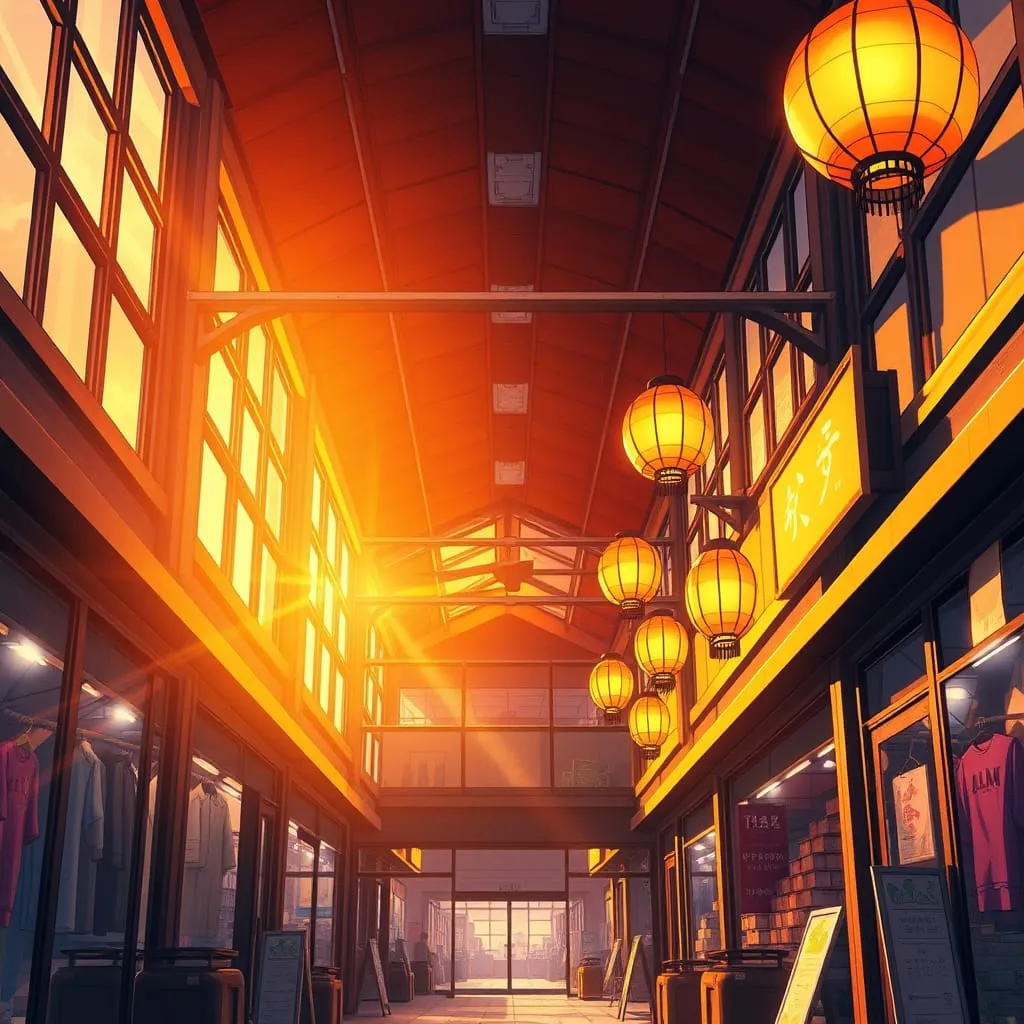
The sun dipped low, casting a bronze sheen across the windows of the shopping mall where paper lanterns hung from the ceiling beams—some promotional display the management had put up weeks ago. They floated on nearly invisible strings above the usual storefronts, tugged gently by the air conditioning. Satoshi walked beside Akira, both of them carrying bags of supplies for the advertisement booth. Akira, as usual, held his tote like it was full of glassware, and wore that ever-thoughtful furrow between his brows that appeared whenever the world failed to meet his exacting standards.
"They changed the dye composition in the paper again," Akira muttered suddenly, adjusting the edge of a bundle of flyers that had shifted. His voice carried that particular tone of someone who had spent far too much time thinking about things others took for granted.
Satoshi glanced at his friend, noting the way Akira's fingers traced the edge of the paper with the reverence others reserved for prayer. "Which means...?" he asked, though he already knew the answer would involve at least three technical explanations he didn't particularly want to hear.
"Which means it'll look cheap when we fold them." Akira's frown deepened, as if the universe had personally offended him. "People will notice. They always notice when things aren't done properly."
Satoshi thought about that idea of notice, of the weight of constant observation, and that to him scrutiny wasn't something that mattered—not in the way it did to others. He was immortal, by all definitions of the word, which meant he'd learned to exist beyond the reach of most judgments. He realized in passing that Akira needed an answer, so he looked back to him and nodded.
"Meaning?"
"Meaning when people expect perfection from you, everything becomes about maintaining the surface." Akira shifted his bag to his other hand, the movement deliberate and thoughtful. "Your conversations have got me thinking recently. I hate how I have to judge myself. The paper has to look right, the folds have to be precise, the booth has to be flawless. Not because it matters to the festival, but because people are watching to see if you'll slip up."
"I keep thinking about what would happen if I just used regular paper," Akira continued, his voice carrying that particular weight of someone who had been mulling over an uncomfortable realization. "If I let people see that sometimes good enough is actually good enough. That the person they think is so meticulous actually makes compromises."
"And what stops you?" Satoshi asked quietly.
"Fear that they'd stop asking me to handle things like this." Akira's voice was gentle but direct. "That if they saw one imperfect fold, they'd assume I couldn't be trusted with anything important." He looked at Satoshi more directly. "The real question is whether we're maintaining these standards because we believe in them, or because we're afraid of what happens if we don't. Whether we're choosing to be meticulous, or just... trapped by appearing to be."
The weight of the observation settled between them as they continued walking. "What if precision isn't something you choose?" Satoshi asked. "What if it's just... what you are? Like my cousin, remember? He's brilliant but chooses to work on a farm. What should be said to him?"
"I guess the question becomes whether you're allowed to be anything else," Akira replied, his voice carrying an uncomfortable understanding. "Whether people would still trust you if your work wasn't perfect."
Satoshi considered that statement—really considered it, the way his mind had been turning over everything lately, searching for the lies hidden beneath obvious truths. "Then don't fold them."
Akira blinked, his entire careful worldview stumbling over two simple words. "That's... that's the tradition."
"That's the habit," Satoshi corrected gently, surprised by his own boldness. The words felt strange, like speaking in a language he was still learning. "There's a difference."
Akira frowned, but not because he disagreed—Satoshi could see that much in the way his friend's shoulders shifted, the slight loosening of his grip on the bag. It was the frown of someone whose perfectly constructed argument had just discovered a crack in its Incubator.
"Still. If we don't do it the way they expect, people will notice."
"I don't think most people care about perfect origami," Satoshi said, watching a group of middle schoolers chase each other between the storefronts, their laughter echoing off the mall's polished floors. "They come for the experience, or the community service hours Kari-san is offering. We’re trying to instill the feeling of doing something together. who cares if it’s a little imperfect?"
The truth of it settled between them as they continued walking, the hum of the mall's ventilation system providing a steady backdrop, above which paper signs flapped weakly like prayers no one was listening to.
"I will," Akira said after a pause, his voice quieter now, more thoughtful. "No one really cares about the paper quality—they just care that I cared about it." He finally stopped fussing over the paper and shook his head. "I don't know which one is more important anymore."
"Maybe both," he said, because it was easier than admitting that some standards felt less like choices and more like prisons you'd built for yourself. “Your choice and others awareness. Align yourself to others awareness”
"Because of responsibility?"
"Because people expect it," Satoshi said, then quieter, as if the words were too fragile for normal volume: "Because we should expect it from ourselves."
And there it was—the truth he'd been circling around for weeks. Not duty or obligation, but the terrible burden of his own standards, the exhausting performance of being exactly what everyone needed him to be, but the knowledge he could be so much more. The weight of the observation settled between them as they continued walking.
They turned a corner into the main atrium of the department store where they'd come to pick up an LED battery pack. The crowd here was thinner, quieter—families browsing with the lazy patience of people with nowhere else to be, teens rehearsing dance routines by the fountain with the self-conscious intensity of youth, an elderly couple arguing over canned mikan with the comfortable irritation of decades together.
And then, ahead of them, a strange stillness that made Satoshi's enhanced senses prickle with attention.
A cluster of people had formed near the elevator, their body language speaking of mild curiosity rather than panic. Not panicked. Just... watching. Murmuring. One security guard stood in front of the panel, half-turned toward the others, trying to appear useful while clearly having no idea what to do.
"She's stuck?" a middle-aged woman asked from the side, craning her neck with the particular fascination people reserved for other people's misfortunes.
"Eh…Not stuck exactly," the guard explained, his voice carrying the practiced patience of someone who'd answered the same question five times already. "The elevator didn't reach the landing properly. It's off by just a few centimeters. Door won't unlock. Maintenance is on the way."
"Someone's inside?" Another civilian asked, stepping closer to the crowd with the careful curiosity of someone who helped solve problems for a living.
The guard nodded. "Yeah. Young woman. She's alright, just startled. Waiting."
Satoshi caught a glimpse through the side window—dim lighting inside, a woman maybe in her mid-twenties, in work attire, standing still with her bag hugged against her chest like armor. She wasn't crying. She wasn't panicking. She was just... waiting. Enduring. The way people learned to endure when shouting didn't help and struggling only made things worse.
It was nothing. A mild inconvenience. No lives in danger. No flames. No screams. The kind of small disaster that would be forgotten by everyone within an hour.
And yet something burned in Satoshi's chest—a familiar ache that felt like watching someone drown in shallow water while everyone else discussed the weather.
Because he could feel it—the tension in the metal, singing against his enhanced senses like a tuning fork. The slightly buckled sensor at the doorframe. The stalled motor above straining gently against its housing. If someone gave it just enough of a push, it would resolve itself. No one would notice. No one would know. The elevator would simply... work. The way elevators were supposed to work, the way a perfect elevator in a perfect world would work.
"Should we stay?" Akira asked softly, his voice pulling Satoshi back to the present. "They've got it under control, I think."
"Maybe," Satoshi murmured, not moving, his body frozen in the space between impulse and restraint.
His hand twitched against his side, fingers wanting to move in patterns that would solve everything in seconds. He didn't need to act. He shouldn't. It would break his rule—don't be exceptional. Don't stand out. Don't solve problems that no one knows exist. Don't be the god among mortals that his mother had trained him to hide.
But his mother's voice echoed anyway: They don't love you. You're too powerful to be loved.
And yet, in front of him: a stuck elevator, a woman invisible to everyone but herself, a broken rhythm in an otherwise perfect machine. A small problem with a simple solution that only he could provide.
The woman in the elevator shifted slightly, and Satoshi caught her reflection in the metallic panel—tired eyes, resigned shoulders, the particular stillness of someone who had learned not to expect rescue.
He stepped slightly to the side, out of direct view of the crowd.
The calculations flowed through his mind like water, precise and inevitable. Push, not too fast, not too sharp. Just a nudge. A whisper in metal. There was a mechanical shift, subtle as breathing. A sound that no one but he noticed as meaningful—the metal finding its proper place, the sensor realigning with microscopic precision. The elevator car adjusted downward by exactly 4.3 centimeters, smooth as silk. A small ripple of joy moved through the watching crowd—the kind of polite acknowledgment people offered when small problems resolved themselves—then immediately faded into dispersal. The woman stepped out, offered a confused but genuine thank-you to the guard who clearly had done nothing.
As if it had never happened. As if the universe had simply corrected itself.
Satoshi felt the aftershock not physically, but internally. A low, warm hum in his chest, like the satisfaction of a perfect note held just long enough at the conclusion of a symphony. A sense of something released, some tension in the world made right. Not because someone had seen—but because they hadn't.
Because for one moment, he had been exactly what he was meant to be, and the world had folded itself neatly back into place, none the wiser.
The feeling was intoxicating. Pure and bright and dangerous as looking directly into the sun.
For those few seconds, he hadn't been Satoshi the secretary, Satoshi the note-taker, Satoshi the perfectly ordinary student council member whose job could be done by a tape recorder. He had been something else entirely—someone who mattered, who could reach across impossible distances and fix what was broken with nothing more than a thought and a gesture.
The woman had looked so grateful to the security guard, so relieved to be free. If she had known it was Satoshi who saved her—really known, understood what he was—would she have looked at him the same way? Or would her gratitude have been modified into something else? Fear, maybe. Or worse, that particular kind of hunger his mother had warned him about: They pray to you, they demand of you, and when you don't give them everything, they begin to resent you.
But this—this perfect anonymity—let him be powerful without consequences. Let him matter without complications. Let him feel exceptional without having to face what people really thought of exceptional things.
"You okay?" Akira asked, watching him more carefully now, those observant eyes noting the slight change in Satoshi's posture, the way his breathing had shifted.
"Yeah," Satoshi said, forcing casualness into his voice. "It's just hot."
The warmth in his chest was already fading, leaving something hollow in its wake. The elevator hummed quietly as it resumed normal operation. The crowd had dispersed. The moment was over, and he was ordinary again—just another student with a bag of festival supplies, invisible in all the wrong ways.
Akira studied him for another moment, then seemed to accept the explanation. They walked away together, leaving the now-functioning elevator behind. But as they left the building, paper decorations fluttering overhead, Satoshi felt something dangerous settling in his chest.
Not guilt. Not pride. Something worse than both—the terrible knowledge that he could feel that good again, anytime he wanted. All he had to do was tell her that he had saved her.
The woman would go home tonight and tell someone—maybe a roommate, maybe a parent, maybe no one—about how she'd been stuck in an elevator for a few minutes. How the door had simply opened, probably just a mechanical hiccup that resolved itself. She would never know that someone had reached across the impossible distance between human and something more, had seen her invisible distress and chosen to act.
She would never know his name. Never know his face. Never know that for one perfect moment, someone had cared about her in a way she couldn't even comprehend. And maybe that was exactly what made it so appealing. No risk. No real vulnerability. Just the pure, unadulterated pleasure of being more than human without any of the human consequences.The thought should have worried him. His mother had spent years teaching him that anonymity was survival, that the moment people knew what you were, you became either a god to be worshipped or a monster to be destroyed. Better to be invisible. But there was something hollow about it too—this perfect, untraceable kindness. Like shouting into a soundproof room. Like being the most important person in a story that would never be told. The high was already fading, leaving behind only the memory of feeling significant and the growing hunger to feel that way again.
"Maybe excellence isn't about doing things the way others expect you too," he said aloud, almost to himself, the words coming from some deep place he hadn't known he was thinking from.
Akira glanced over, eyebrows raised. "Then what is it about?"
Satoshi considered it, watching the lanterns dance in the air currents, thinking about folded paper and broken elevators and the difference between habits and traditions. About invisible threads and invisible currents and invisible hands that moved the world in ways no one would ever notice.
"Choosing to keep carrying something," he said finally, "even when no one sees you do it."